What Credit Score Do You Need to Buy a House in 2025?

Jennifer Hernandez • February 17, 2025

If you’re planning to buy a home, one of the most important questions on your mind is probably: What credit score do I need to qualify for a mortgage? I’m here to save you hours of research and give you the real facts that matter most. We’ll cover the minimum credit score requirements for various loan types, from conventional to FHA, VA, USDA, and portfolio loans. Plus, read to the end for a bonus tip on how to boost your credit score by 40 to 50 points—fast!


Understanding Credit Scores for Mortgages


Not all credit scores are created equal. While you may see one score when checking your credit card or car loan, the FICO score used for mortgages could be different. There are over three dozen FICO models, but 90% of lenders rely on one specific version for mortgages.

💡 Pro Tip: The best way to know your mortgage FICO score is to check with a licensed mortgage lender.

Minimum Credit Score Requirements by Loan Type

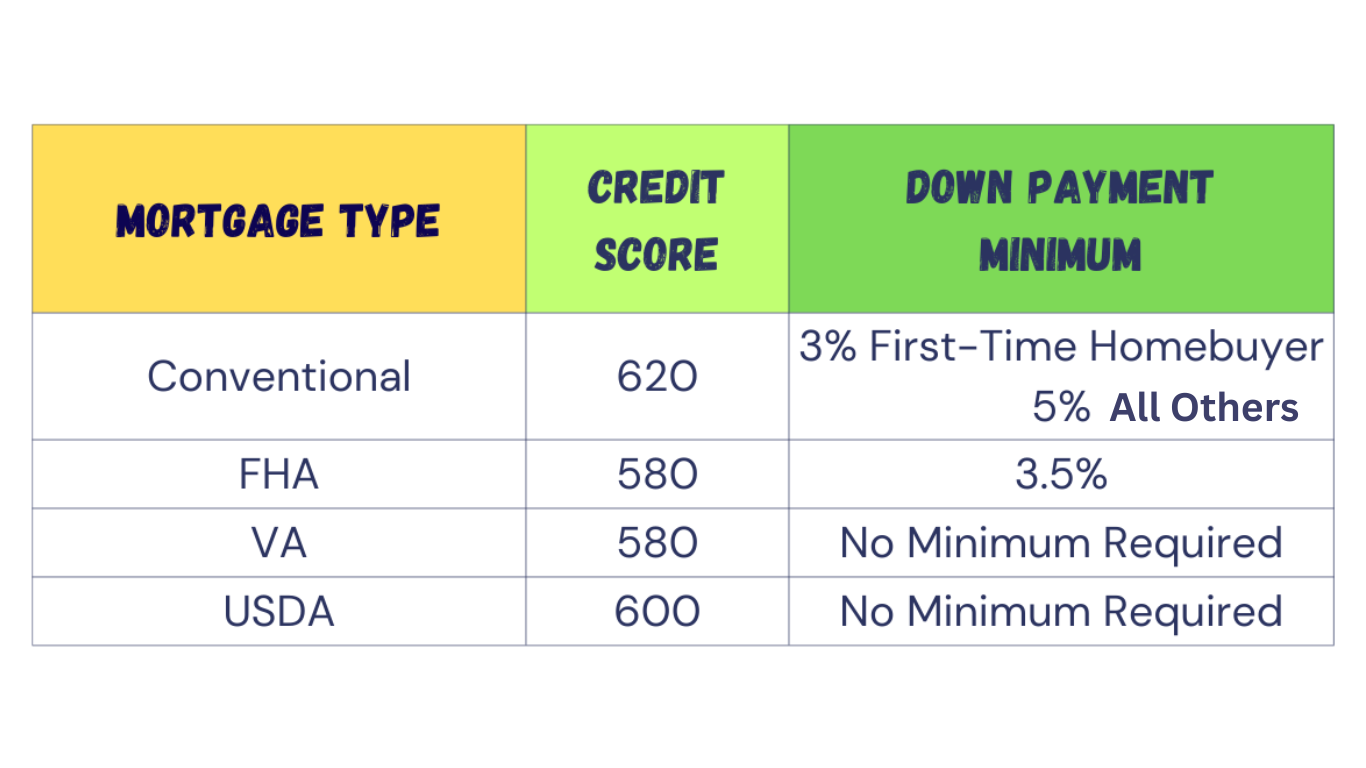
Here’s a breakdown of minimum credit scores for different loan programs:


1. Conventional Loans


  • Minimum Score: 620 if you have at least a 20% down payment
  • Less than 20% down payment: Aim for a credit score of at least 680
  • Best Rates: 740+ if you want the best interest rates available

Conventional loans are stricter on credit scores however offer the best terms and interest rates to borrowers with higher scores. If your credit score is below 680, you may face higher rates and stricter requirements.

👉 Learn more: Watch my video on Conventional Loans to see if this is the right loan for you.


2. FHA Loans


  • Minimum Score: 580 (some lenders may allow down to 550, but it’s rare)
  • For Best Terms: 640+

FHA loans are a popular option for first-time homebuyers because they allow lower credit scores. However, if your score is below 600, be prepared for additional requirements like having reserves and low payment shock.

👉 Check out my full guide: What You Need to Know About FHA Loans for 2025


3. USDA Loans


  • Minimum Score: 620 (required by most lenders)
  • Restrictions: Rural properties only, income limits apply

USDA loans are limited to rural areas and have strict debt-to-income ratio requirements. This program works well for those who qualify.  Only about 4% of the mortgages are USDA due to its restrictions.

👉 Explore USDA eligibility: USDA Property Eligibility Map


4. VA Loans


  • Minimum Score: None set by VA (however most lenders require at least 580)

VA loans offer some of the most flexible credit requirements and are available to eligible veterans and their spouses. Keep in mind that VA loans don’t allow co-borrowers other than a spouse.

👉 Watch: VA Loans Explained


5. Portfolio and Non-QM Loans


  • Minimum Score: Typically 680+

Portfolio and Non-QM (Non-Qualified Mortgage) loans are more flexible and designed for unique situations—like using bank statements or profit-and-loss statements to qualify. However, they come with higher interest rates, especially for lower credit scores.


Bonus Tip: How to Increase Your Credit Score Fast to Get the Best Interest Rate


Want to boost your credit score by 40 to 50 points in just a couple of months? Follow this simple strategy:

  1. Credit Card Utilization: Keep your balance below 30% of your credit limit when your statement closes. For example, if your statement cuts off on the 8th, ensure your balance is under 30% on that date.
  2. Limit the Number of Credit Cards: Having no more than two or three credit cards can improve your score.
  3. Focus on Payment History and Utilization: These two factors make up 65% of your FICO score.
  4. Don’t be late making payments!  Pay on time, every month.


👉
Want more credit tips? Check out my Credit Playlist.


Your credit score plays a significant role in determining your mortgage options and interest rates. The higher your score, the more favorable your terms will be. If you’re serious about buying a home, take steps to monitor and improve your credit score with the tips above.

For personalized advice, reach out to a mortgage expert, and don’t forget to check out my other videos and blog posts for even more home-buying tips.

💬 Have questions? Reach out to me directly—I’m happy to help!


By Jennifer Hernandez July 10, 2026
If you bought your Houston home before 2022, you're likely sitting on a goldmine of equity—and you might be wondering how to tap into it without touching that beautiful 2%, 3%, or 4% mortgage rate you locked in. Maybe you're thinking about home improvements, consolidating high-interest debt, or building a financial cushion for your next move. Whatever your reason, you're not alone. More Houston homeowners than ever are exploring ways to access their home equity while keeping their low-rate first mortgage intact.  The good news? You have options. The two most popular are HELOCs (Home Equity Lines of Credit) and home equity loans—and while they sound similar, they work very differently. In this post, I'll break down what each one is, how they work, and which might be the better fit for your financial goals. No jargon, no runaround—just the facts you need to make a smart decision.
By Jennifer Hernandez July 8, 2026
If you're trying to buy your first home in Houston but keep getting turned down for a mortgage—or pre-approved for way less than you expected—your credit cards might be the culprit. It's not always about late payments or poor credit. Sometimes, it's simply about how much you're paying *monthly* on those balances and how close you are to maxing out each card. Right now, Americans are carrying over $1.3 trillion in credit card debt, and with inflation driving up the cost of groceries, gas, and just about everything else, a lot of Houston families are relying on plastic just to get by. But here's the catch: even if you're making every payment on time, high credit card balances can quietly disqualify you from getting a mortgage—or drastically lower the home price you can afford. The good news? With some strategic planning 9–12 months before you're ready to buy, you can turn this around. How Credit Card Payments Affect Your Mortgage Approval When a lender reviews your mortgage application, they're not just looking at your credit score—they're calculating your debt-to-income ratio (DTI). That means they add up all your monthly debt payments (credit cards, car loans, student loans) and compare that to your gross monthly income. Here's the kicker: every $300 per month in credit card payments can reduce your buying power by $40,000 to $50,000 . Let that sink in. If you're paying $600/month across a few cards, you could be losing access to nearly $100,000 in your home-buying budget. And lenders go off the minimum payment shown on your credit report , not your actual balance. So if you're enrolled in one of those "pay off faster" plans where you agreed to pay more each month, your credit report reflects that higher payment—and the lender counts it against you. Why Credit Card Utilization Tanks Your Credit Score Your FICO score is made up of several factors, but 30–35% of it is based on credit utilization—meaning how much of your available credit you're actually using. If you have a $5,000 limit and you're carrying a $4,500 balance, that's 90% utilization, and it hurts your score. Here's what surprises most first-time buyers: lenders look at each card individually, not your overall total . So even if you have two cards with zero balances, if you're maxed out on two others, your score takes a hit. The Ideal Credit Card Setup Most people don't know this, but the sweet spot is **two major credit cards—ideally a Visa or Mastercard that you can use anywhere. Those department store cards, gas station cards, and retail "rewards" cards? They're often doing more harm than good. If you've got more than two or three cards, it's time to start closing the ones you don't actively need. What You Can Do Right Now to Improve Your Mortgage Chances If you're stuck in the credit card hamster wheel, don't panic. You're not alone, and this is fixable. Here's your action plan: 1. Pay Down Balances Strategically Don't worry about interest rates just yet. Focus on paying off the smallest balances first . Knocking out a couple of smaller cards quickly gives you wins and frees up mental bandwidth. Once a card is paid off, close it (if you have more than two cards). Getting those accounts to zero and reducing the total number of open credit lines will help your score rebound faster. If you have several cards, throw a little money at each one to lower your utilization percentages across the board — but prioritize eliminating full balances when possible. 2. Call and Negotiate Yes, you can actually call your credit card company and ask for a lower interest rate. It doesn't always work, but it costs nothing to try. Focus on cards you've had the longest—companies reward loyalty more often than you'd think. 3. Consider a Balance Transfer You've probably gotten those 0% balance transfer offers in the mail. If you're 12+ months away from buying a home, this can be a smart move. Transfer high-interest balances to a 0% card, which frees up cash flow to pay down other debt faster. Just be aware: transferring a $10,000 balance to a $10,000 limit card means that card is now 100% utilized, which will temporarily ding your score. But if you're playing the long game and paying it down aggressively, it can work in your favor. 4. Set Up Autopay for Minimum Payments **Late payments make up another 35% of your credit score.** Between utilization and payment history, that's 70% of your score right there. Set every card to autopay at least the minimum. Then, once a month after payday, go in and make extra payments on the cards you're targeting. This way, you'll never accidentally miss a due date. Pro tip: Ask your credit card company if you can change your due date to line up with your paycheck. Not all will do it, but many will.
realtor providing the easiest way to buy a house
By Jennifer Hernandez July 29, 2025
Buying a house is a big process and if you don't use a Realtor, you are missing out on expertise that can save you thousands of dollars and hundreds of hours.
Person reviewing paperwork for a loan application.
By Jennifer Hernandez July 22, 2025
Being honest on your loan application is important. The consequences of lying on your loan application can be costly, time-wise and financially.
mortgage payment went up?
By Jennifer Hernandez July 15, 2025
Mortgage payments go up even if you have a fixed interest rate due to property taxes and insurance. Get a few tips on how to prepare for those increases.
baby boomer couple enjoying coffee on the porch
By Jennifer Hernandez July 8, 2025
Staying in your own home as you age is a priority for most homeowners. No one wants to have to leave the comfort of their home to go somewhere new.
Couple Smiling looking at document to see if they are ready to buy a house
By Jennifer Hernandez May 19, 2025
Buying a home is one of the biggest financial and emotional decisions you'll ever make. But how do you really know if you're ready? In this article, we’re breaking down five clear signs that you might be ready to buy a house—and one red flag that means you may want to wait. Whether you’re a first-time buyer or just testing the waters, this guide will help you move forward with clarity and confidence. Sign #1: You’re Financially Stable The first green light? Consistent income and job stability. If you’ve had a steady paycheck for at least two years (especially in the same industry), that’s a strong start. But it goes deeper than income: You should also have: An emergency fund covering at least 3–6 months of expenses Savings for a down payment (typically 3%–20% of the home price) Money for closing costs and moving expenses Pro Tip: Many buyers underestimate how much they’ll need after the down payment. Check out this mortgage planning article to avoid that mistake. Texas-Specific Tip: Texas has no state income tax—but property taxes are higher than the national average. Be sure to budget accordingly. You can estimate local taxes via the Texas Comptroller’s Property Tax site. https://comptroller.texas.gov/taxes/property-tax/rates/index.php Sign #2: You’ve Got Manageable Debt & Decent Credit Your debt-to-income ratio (DTI) and credit score directly impact your ability to qualify for a mortgage—and the rate you’ll get. A credit score above 620 is usually the minimum for most loan types The higher your score, the lower your interest rate—potentially saving you thousands over time If you're carrying high-interest debt, it might be wise to pause and reduce it before buying Your debt-to-income ratio is under 55%. Want to learn more? Watch How Your Credit Score Affects Your Mortgage . Sign #3: You’re Ready to Stay Put Buying a home makes more sense if you plan to stay in one place for at least 3–5 years. Why? Because selling a home comes with closing costs, commissions, and possibly capital gains taxes. If you move too soon, you may not have built enough equity to make it financially worthwhile. Ask yourself: Are you planning to stay in the same city or job? Do you feel ready to settle down a bit? Sign #4: You’re Ready for the Responsibilities of Ownership Homeownership isn’t just about finances—it’s a lifestyle shift. Are you ready to: Maintain a yard Handle repairs Budget for appliances or home upgrades These are everyday realities renters don’t usually deal with. If you’re ready to take that on, it’s a strong sign you’re ready to buy. Need a reality check? Watch The Real Cost of Homeownership for a behind-the-scenes look. Sign #5: You’ve Budgeted for the Full Cost of Homeownership It’s easy to focus just on your monthly mortgage payment—but that’s only part of the picture. You also need to budget for: Property taxes Homeowners insurance Maintenance and repairs HOA fees (if applicable) If you’ve run the numbers and still feel comfortable, you’re probably in good shape. Red Flag: You’re Buying Out of FOMO If your motivation to buy a house is: Everyone else is doing it You’re afraid of being priced out You feel pressured by social media or family Take a step back. Fear of Missing Out (FOMO) is not a solid reason to buy a home. Your decision should be based on your goals, your finances, and your lifestyle—not the market hype. Not Sure If You’re Ready? We’ve Got You Covered Download our free Homebuyer Readiness Checklist to see where you stand Check out our Blueprint to Homeownership course for a step-by-step guide through the buying process Bottom Line Buying a house isn’t something to rush—but with the right preparation, it can be one of the most rewarding decisions you ever make. If you feel financially stable, ready for long-term commitment, and confident in your lifestyle plans—you may be ready to take the next step. Have questions? Reach out here Book a 15 Mins Call and we’ll walk you through it. Want more clear, honest mortgage advice? Subscribe to Loan With Jen on YouTube
Family watching a house to decide if they can afford it
By Jennifer Hernandez May 12, 2025
Think you can’t afford to buy a home? You might be surprised. The income you actually need may be lower than you think. In fact, most people are asking the wrong question entirely. In this post, we’ll break down: How lenders really decide what you qualify for A simple formula to estimate your price range Why your debt matters more than your income Plus—how first-time buyers get approved with less than you’d expect It’s Not Just About Income—It’s About Debt-to-Income Ratio (DTI) Most people think income alone determines your buying power. But lenders focus more on your Debt-to-Income Ratio (DTI) . Here’s how DTI works: Your total monthly debt ÷ your gross monthly income = your DTI Most lenders want this ratio to be 45% or lower , though some loan programs will allow more. This calculation includes: Your new mortgage payment Property taxes Insurance HOA fees (if applicable) Any car loans, student loans, or credit card minimum payments Example: Let’s say you make $75,000 per year—that’s $6,250/month gross income. 45% of that = $2,812 Now subtract your monthly debts: Car loan = $500 Credit card payments = $300 Total = $800 That leaves you with about $2,000/month for a mortgage payment. What Kind of House Does $2,000/Month Get You? With interest rates around 6.5% , that could get you a home priced at $260,000–$280,000 , depending on your: Down payment Property taxes Location HOA dues Of course, this is just an estimate. You can plug your numbers into a mortgage calculator to get a more accurate idea based on your location and situation. How Loan Types Impact Income Requirements Your loan program plays a big role in how much home you can afford. Here’s a quick breakdown: FHA Loans : Allow DTIs up to 50%, and only require 3.5% down VA Loans : For veterans—no down payment required and very flexible income requirements Conventional Loans : Stricter guidelines; usually require 43–45% DTI and 3–5% down USDA Loans : No down payment, but must be in eligible rural areas and meet income caps And remember— a larger down payment means a smaller monthly mortgage , which helps you qualify for more. Credit Scores and Reserves Matter Too Even if you qualify on paper, your credit score and cash reserves play a key role: Higher credit score = lower interest rate = lower monthly payment Reserves are how much money you have in the bank after closing. Many lenders require at least 1–2 months of mortgage payments in reserves. Even if your income is borderline, having reserves can tip the scales in your favor. Real Buyer Stories: It’s More Possible Than You Think Story 1 : A couple earning $90K/year thought they needed to wait because of student loans. But with FHA, 3.5% down, and minimal other debt, they got approved for $325K—and closed on a home last month. Story 2 : A single teacher earning $52K/year bought a $210K condo using just 3% down and a first-time buyer grant. She didn’t think she qualified—until she did. Don’t Forget Side Income or Co-Buying You might qualify for more than you think if: You co-buy with a spouse, parent, or sibling You have side income (Uber, freelance, small business) that’s been on your taxes for at least 2 years That extra income can help you get approved. The Formula: Estimate What You Can Afford Here’s a quick formula to ballpark your buying power: Take your gross monthly income Multiply by 0.45 (max DTI) Subtract your monthly debts The remainder is your max mortgage payment (including taxes & insurance) Use a mortgage calculator to plug in that number and see what home price you might qualify for. Online mortgage calculators don’t take tax or insurance into consideration most times, but this will give you a ballpark figure. Before you get your heart set on a house though, reach out to a lender to find out your true buying power. It costs you nothing to get this information! Bottom Line: You Probably Don’t Need Six Figures to Buy a Home Most buyers are surprised by what they can afford. The key is understanding how lenders look at your full financial picture—not just your income. You don’t have to guess. And you don’t have to go it alone. Next Steps Take our FREE Blueprint to Homeownership course for a step-by-step guide Reach out to our team for a free strategy call —we’ll help you crunch the numbers and create a plan If you found this helpful: Subscribe to the Loan With Jen YouTube channel for weekly tips
Woman removing wedding ring, with miniature house and legal documents symbolizing divorce.
By Jennifer Hernandez May 5, 2025
You’re not starting over—you’re starting fresh. And yes, you can buy a home after a divorce. If you’re navigating a divorce or separation, I want to start with this: Big hug. Big kiss. This season of your life might feel uncertain or overwhelming, but you’re not broken. You’re rebuilding—and I’m here to help. Let’s walk through the 5 most common mistakes people make when trying to buy a house after divorce —and how to avoid them. 1. Your Credit Tells the Real Story—Not Just the Divorce Decree Here’s what most people miss: Even if a divorce decree says your ex is responsible for a shared mortgage or credit card, your name on the account means it’s your responsibility in the lender’s eyes. That means: Late payments by your ex will still hit your credit. A mortgage that your ex was supposed to refinance but didn’t? Still counts against your debt load. What to do: Pull your full credit report from all 3 bureaus : Experian, Equifax, and TransUnion Review all joint accounts : Are they closed? Paid off? Still open? Check if your ex has refinanced you off the mortgage —don’t assume, verify! Collect documentation if the mortgage responsibility was transferred Pro Tip: As a lender, I can do a soft credit pull for you—no ding to your score—to identify red flags before you apply! 2. Income After Divorce—What Counts (and What Doesn’t) Post-divorce income can be complex. Whether you're earning on your own or receiving support payments, lenders need proof of stability and consistency . What lenders typically require: W-2 income or 2 years of self-employment returns At least 3–6 months of child support or alimony payments (with documentation) A copy of your final divorce decree or court-ordered support agreement Watch out for: Informal payments (Venmo, cash) with no paper trail Newly ordered support that hasn’t been received yet Significant drops in income—these must be accounted for Pro Tip: If your income has decreased after divorce, we can explore co-borrowers, grants, or flexible loan programs to help you qualify. 3. The Old Mortgage Can Haunt You (Even If You Don’t Live There) Even if your ex is living in the home and paying the mortgage, if your name is still on the loan, it counts against your debt-to-income ratio. This can affect how much you qualify for—even if you’re renting now or planning to buy something smaller. How to handle it: Ask your ex to refinance the home and provide a release of liability from the lender. Ask the lender - before you are off the loan and still authorization to speak to the lender - to provide you with instructions on how to receive a release of liability. If refinancing isn’t happening, collect 12 months of canceled checks or bank statements showing your ex is paying from their own account If those options aren’t possible, you may need to wait until the home is sold or work with a lender who understands how to navigate this scenario 4. Don’t Skip the Emotional Prep—Buying a Home Is a Big Deal Divorce doesn’t just impact your finances—it affects your emotions, too. Even if you're financially ready to buy, make sure you’re mentally and emotionally ready to take on homeownership again. This is especially true if you're moving from a home that holds memories or are co-parenting with children. Ask yourself: Am I rushing to buy just to feel “settled”? Is this home choice based on my new lifestyle , not my old one? Do I have the support system and clarity to take on this responsibility? Mindset Tip: Your next home should support your fresh start , not keep you tied to the past. You’re building your life now—on your terms. 5. Timing Is Everything—Don’t Rush the Process After a divorce, it’s tempting to try and “fix” everything fast. But buying a home is a major financial move, and sometimes waiting just a few months can make a big difference. Reasons you may want to pause briefly: Waiting for credit to improve Gathering more documentation or saving for a down payment Giving support payments time to become “seasoned” (most lenders want 3–6 months of consistent payments) That said, you don’t have to put your life on hold forever. The key is working with someone who knows the post-divorce lending landscape and can help you make informed choices. You’re Not Alone—And You Can Do This Whether you're newly separated or a year into your new chapter, you deserve a place to call your own. And you don’t have to navigate this alone. Ready to get started? Here are your next steps Get a free credit and income readiness review —just message me Take my Blueprint to Homeownership course if you want a full step-by-step roadmap. You’ve got options. You’ve got support. And most importantly—you’ve got this. I’m here to help you rebuild with confidence. Let’s find your fresh start.
More Posts